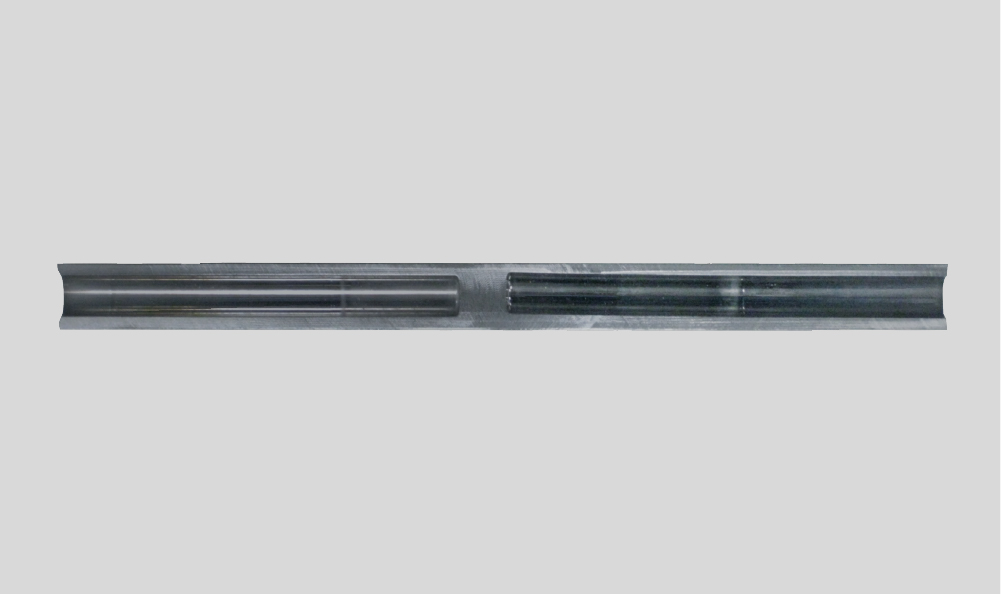
In the automotive industry, balancing weight reduction with cost reduction is an eternal challenge. Particularly in the manufacturing of hollow components, “deep-hole forming from solid material” as an alternative to expensive seamless pipes is an extremely effective method. However, it faces a significant barrier: the physical limits of processing.
This article explains the behind-the-scenes development of how we achieved deep-hole forming with an L/D ratio of 10, significantly exceeding standard processing limits, through the three perspectives of die design, simulation, and proprietary expertise.
| Application | Automotive Parts |
| Material | Alloy Steel, Carbon Steel |
| Process | Cold Forging |
| Forging Load | 15tonf |
| Development Period | 3 Months |
Development Background and Challenges
Hollow components, such as pipe structures and hollow shafts, play a crucial role in reducing the weight of automotive parts. However, purchasing pre-hollowed pipe material is expensive because the material cost already includes processing fees. Therefore, forging deep holes from inexpensive solid bar stock is a highly effective alternative.
Furthermore, forging allows for the formation of non-through holes in a single process, eliminating the post-processing steps and costs that are unavoidable when using pipe materials.
To achieve both cost reduction and lightweighting at a high level, advanced forging technology capable of forming high-precision deep holes from solid materials is required.
Challenging L/D=10: Transcending Conventional Limits
While deep-hole forming is a potential key solution for cost and weight reduction, there are physical limits to the depth of processing. In terms of the L/D ratio (the ratio of depth to diameter), typical mass-production results are around L/D=4 to 5. Once the ratio exceeds L/D=8, issues such as extremely short die life and product eccentricity become prominent, even if the shape can be formed.
In this development, we challenged and successfully cleared the highly difficult hurdle of L/D=10 deep-hole forming, significantly surpassing the technical wall. Below, we explain the specific development points that led to this breakthrough.
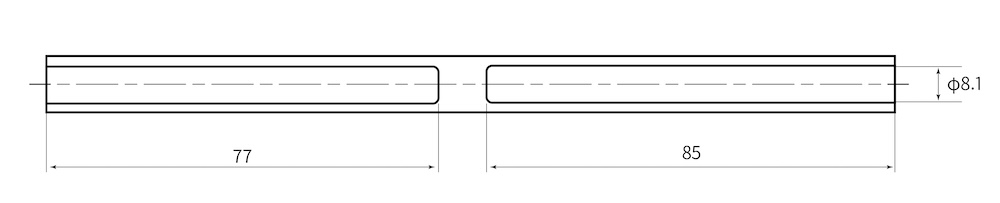
Development of High-Strength Punches and Optimal Design
To realize L/D=10 deep-hole forming, it is essential to minimize punch breakage and deformation caused by the forming load. The load on the punch increases exponentially under conditions where area reduction ratio (e.g., when the wall thickness is extremely thin or thick relative to the hole diameter).
To avoid this, we combine proprietary die designs—incorporating various countermeasures and technical know-how—with the selection of optimal die materials and micron-level precision die-making technology. This synergy prevents premature punch failure and deformation even in harsh forming environments.

Proprietary Expertise: Suppressing Lubrication Failure and Punch Deflection
In deep-hole forming, the extremely long stroke length carries a constant risk of lubrication failure, leading to “galling (adhesive wear).” To counter this, we select the optimal coating based on our extensive track record and implement process and die designs that maximize tool life.
Furthermore, to prevent “eccentricity” (where the inner diameter shifts relative to the outer diameter due to punch bending), we minimize punch deflection by optimizing the die structure and rigidity. The preparation of the material is also vital; we propose and implement the best methods based on our know-how, ranging from annealing in previous steps to specialized lubricant supply methods.
Pre-Verification and Optimization of Strength and Deformation via CAE
In this development, where punch strength is the lifeline, the thorough use of CAE analysis to visualize internal behavior during forming was indispensable. In the L/D=10 realm, even a slight imbalance in load leads directly to punch breakage or product eccentricity. Relying solely on physical trial-and-error would be extremely risky, time-consuming, and costly.
Specifically, we verify punch strength and deformation during the design stage to determine the most advantageous punch geometry. We also simulate whether the product will fracture and if the required shape can be achieved, incorporating countermeasures from the very first prototype.
By repeating verification in a virtual environment, we minimize risks such as premature die failure while preparing for any potential issues. This allows us to derive the optimal solution for achieving the required precision in the shortest possible time, drastically improving development efficiency.

Pushing the Limits of Deep-Hole Forming: Solving Hollow Shaft Challenges with Technology
The L/D=10 deep-hole forming technology introduced here is the result of our relentless innovation and years of accumulated expertise. Even for hollow components like shafts that other companies have deemed “impossible” or that were abandoned due to cost, our combination of advanced forging processes and analysis technology may open a path to realization.
If you are considering a transition from pipe materials to achieve significant cost savings or pursuing lightweighting, please consult with us. We will powerfully support your product development with our proven technical capabilities.
Author Profile

H.T Director, Solution Division, Yamanaka Eng Co., Ltd.
H.T is a veteran engineer who has dedicated his entire 43-year career to the field of forging. During his long tenure at a major automotive manufacturer, he mastered every stage of the process—from die design and equipment installation to new component launches and the development of advanced forging methods. His technical expertise is highly recognized in the industry, highlighted by his prestigious receipt of the "Sokeizai Industry Technology Award" on two separate occasions.