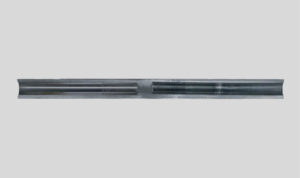
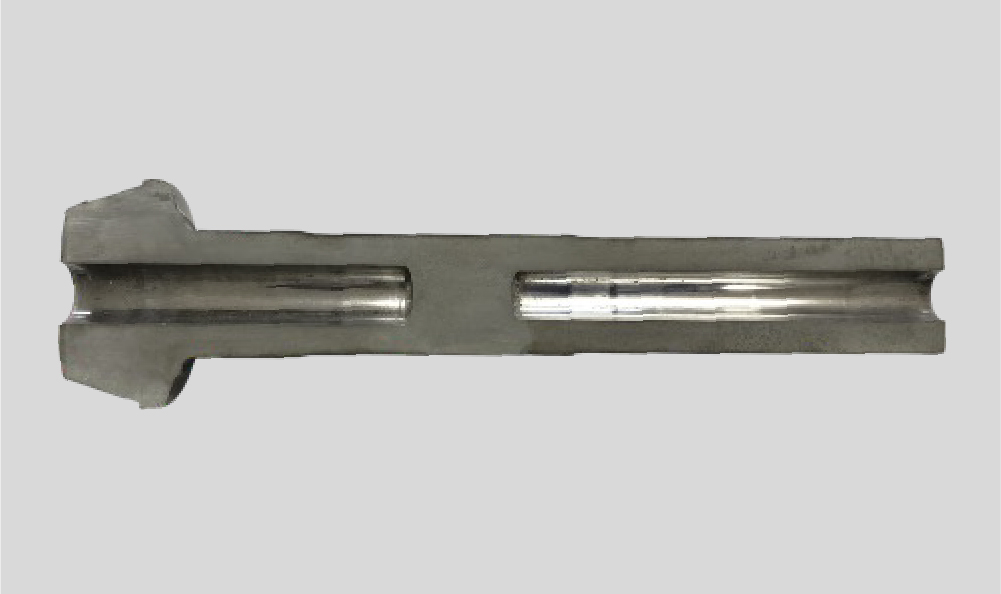
This development case study highlights how high-precision cold forging achieved cost reductions and weight savings for a hollow shaft used in automotive parts—objectives that were previously difficult to realize using conventional machining (gun drilling). (Note: This is a joint development project with our customer.)
| Product Name | Hollow Shaft |
| Application | Automotive Parts |
| Material | SCr420 or SCM420 |
| Dimensions | Length:265.8mm Inner Diameter:φ15 Outer Diameter:φ34.8 |
| Process | Cold Forging |
| Forging Load | 500tonf |
| Development Period | 3 -5 Months |
Development Background and Challenges
Conventionally, machining (gun drilling) has been the mainstream method for manufacturing shaft parts where a hollow structure is required by specification or intended for weight reduction. However, this method posed challenges, including increased material and processing costs, as well as low productivity.
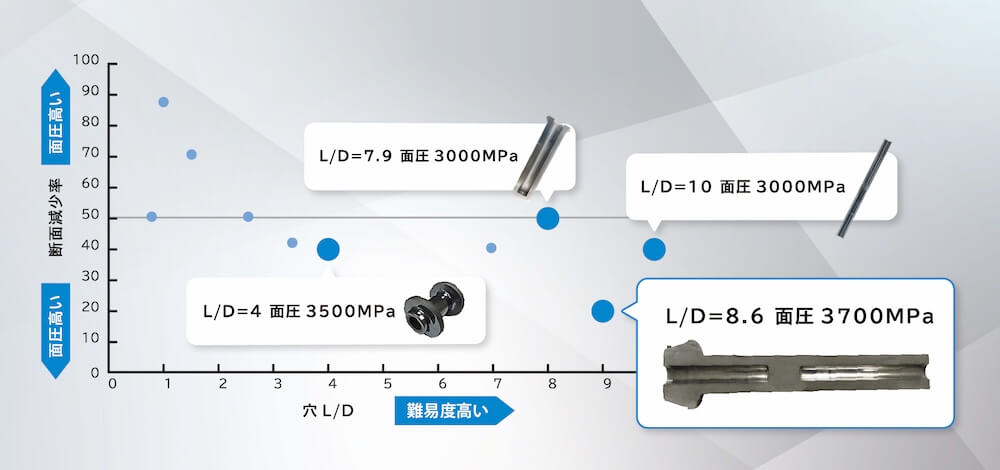
To achieve weight reduction cost-effectively, shifting the manufacturing method to forging was determined to be the optimal solution. The ultimate technical hurdle in developing this forged hollow shaft was forming a long hole while maintaining high precision. Specifically, it was necessary to achieve an extremely difficult deep hole with a length-to-diameter (L/D) ratio of 9x—significantly exceeding the standard mass-production track record of around 3x to 5x.
Minimizing Eccentricity via Special Die Structures and Punch Design
To achieve this highly challenging deep-hole forging, we co-developed a structure with our customer to minimize the eccentricity of the inner diameter relative to the outer diameter. A special die structure and optimized punch design played a crucial role in enabling forming at such a high L/D ratio.
Specifically, the position, length, and clearance of the punch guide have been optimized so that the punch initiates forming exactly at the center of the product during the initial stage and advances with minimal deviation throughout the process. This guiding mechanism stabilizes the punch axis, suppressing localized loads and wear. Furthermore, by optimizing the shape of the punch tip itself—the key to successful forming—we achieved highly precise eccentricity control during long-length deep hole processing.
Punch Longevity Measures Powered by Accumulated Expertise
To withstand high surface pressure and enable mass production, extending the lifespan of the punch was another critical point in development.
To prevent the punch from bending, its length was kept as short as possible, and a straight, uniform diameter profile (resembling a barrel) was adopted.
Based on our accumulated knowledge and expertise, we carefully selected the punch material (carbide), which significantly impacts tool life, and combined it with the optimal surface treatment to achieve a longer lifespan under high surface pressure environments.
Optimizing Complex Forming Processes and Motion Settings via CAE
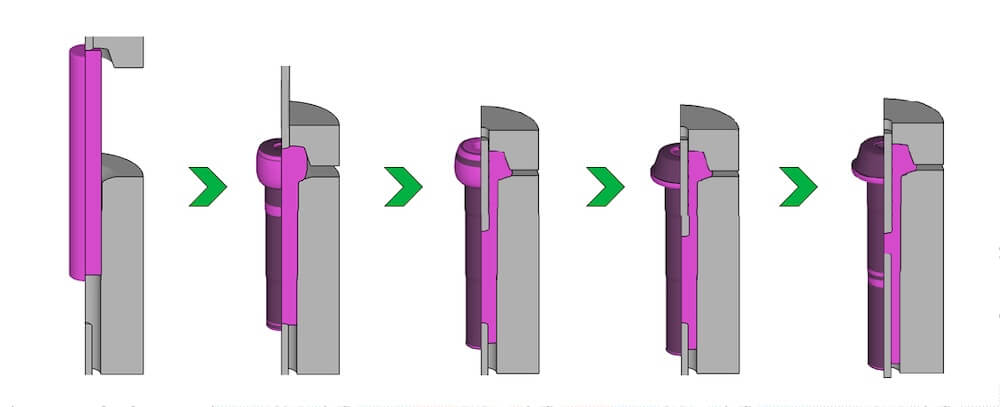
This component is not a simple rod; it features a complex shape with a head (flange section). Formulating both this head section and the internal deep hole simultaneously within a single-shot process required highly sophisticated engineering.
To reduce trial-and-error costs during prototyping, we conducted thorough CAE verification in collaboration with our customer. Simulation results revealed that a process sequence—where the head is upset (compressed) first before the hole is formed—was the most suitable for single-shot forming. Furthermore, we used CAE to run detailed simulations of fine motion conditions, such as the timing and speed of piercing the hole while compressing the head. Finding these optimal conditions enhanced development efficiency and increased the success rate.
Technological Development Capabilities to Meet Demanding Requirements
Yamanaka Gokin is capable of proposing optimal manufacturing methods and supporting product commercialization with the highest precision, even for highly demanding requirements such as this 9x L/D deep-hole forging.
This is made possible by our deep knowledge and expertise in forging accumulated over many years, alongside our proven track record of developing over 1,500 forged products.
By fusing the insights gained from these achievements with advanced CAE technology, we derive theoretical and efficient solutions for complex challenges. With this strength, Yamanaka Gokin will continue to be a partner that turns our customers’ challenging demands into reality.
Author Profile

H.T Director, Solution Division, Yamanaka Eng Co., Ltd.
H.T is a veteran engineer who has dedicated his entire 43-year career to the field of forging. During his long tenure at a major automotive manufacturer, he mastered every stage of the process—from die design and equipment installation to new component launches and the development of advanced forging methods. His technical expertise is highly recognized in the industry, highlighted by his prestigious receipt of the "Sokeizai Industry Technology Award" on two separate occasions.