
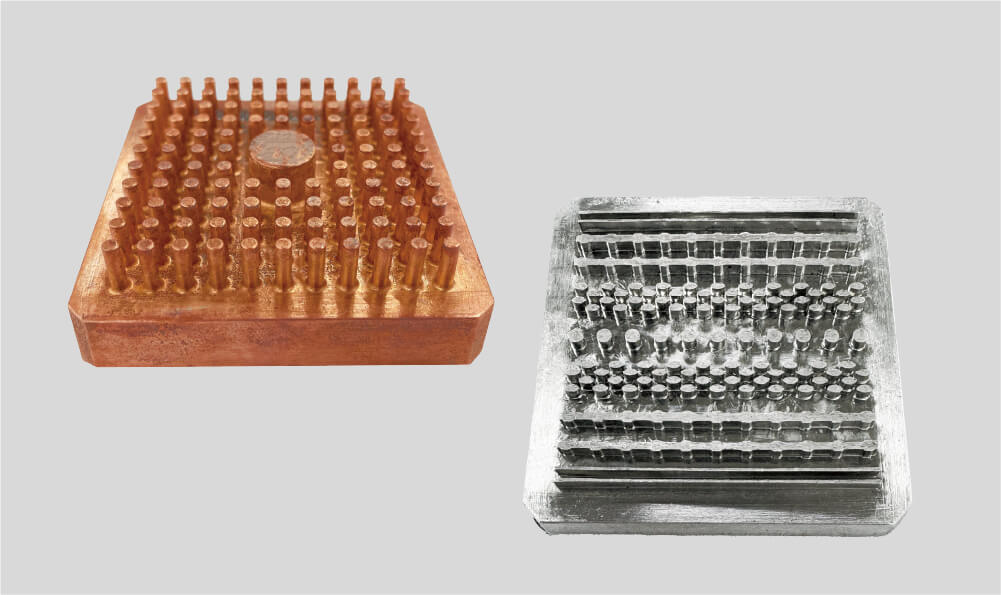
This development case study focuses on the transition to forging for heat sinks—critical cooling components used in automobiles and various electronic devices—aiming to achieve both high cooling performance and superior productivity.
| Product Name | Heat Sink |
| Application | Automotive, Various Electronic Devices |
| Material | Copper / Aluminum |
| Dimensions | 64×65mm |
| Process | Cold / Warm Forging (up to 300°C) |
| Forging Load | 300 tonf – 600 tonf |
| Development Period | 3 Months |
Development Background and Challenges
With the rapid electrification of vehicles and the expanding adoption of power electronics, the demand for heat sinks as cooling components is surging. Traditionally, heat sinks were manufactured through processes like machining. However, machining complex fin shapes is time-consuming, making it difficult to meet increasing production volumes.
Against this background, forging has gained attention for its ability to significantly reduce processing time and offer high productivity compared to machining. Furthermore, because forged parts are formed under high pressure, they have fewer fewer internal voids (lower porosity) and higher material density. This enhances thermal conductivity and results in superior cooling performance. Consequently, forging is highly anticipated as a next-generation manufacturing technology for heat sinks, offering both improved productivity and higher performance.
Eliminating Machining and Improving Pin Height Precision via Back-Pressure Control
A common challenge in forging heat sinks—especially those with fine pin structures—is that material may not flow evenly into every corner of the die. This often results in uneven pin heights, where the outer pins are longer and the central pins are shorter. Consequently, post-process machining becomes mandatory, which negates the productivity benefits of switching to forging.
By utilizing multi-axis double-action presses or presses equipped with back-pressure mechanisms, we have successfully achieved uniform material flow to the very tips of the pins by applying back-pressure during the forming process.
As a result, it is possible to form pins with excellent height precision (uniform heights), eliminating the need for post-forging machining. This contributes to significant cost reductions and enhanced productivity.

Accommodating Various Pin Shapes and Techniques for Maintaining Pin Geometry
We are capable of forging various pin geometries, including elliptical pins. Elliptical pins are particularly effective as they increase surface area, leading to even higher cooling performance.
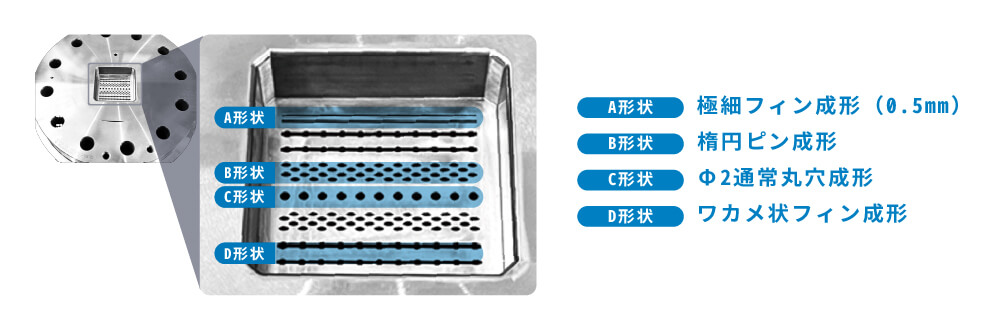
In this case study, we produced samples focusing on the pin section. However, actual products often involve complex plate shapes, such as those with integrated bolt-mounting surfaces. Beyond pin forming, we propose manufacturing solutions tailored to various scenarios, including the limitations of your existing equipment or cost differences based on material procurement routes.
Optimal Design via CAE and Handling Large-Scale Sizes
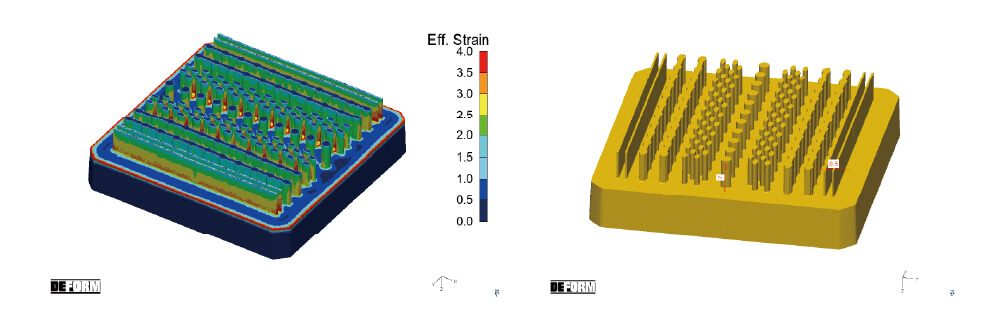
To reduce the costs associated with trial-and-error prototyping and to meet highly difficult requirements, pre-verification using “DEFORM” CAE software plays a vital role.
While the sample in this case is 64 x 65 mm, as heat sinks increase in size, the required forming load also increases, sometimes exceeding the capacity of existing press equipment. We utilized CAE to solve this problem.
Specifically, we visualized the load distribution and forming behavior during the process using CAE. Based on our extensive design experience and know-how, we revised the forming stages to ensure the load remains within target limits. By running multiple simulations on the revised design, we can identify the optimal design that allows large-scale heat sinks to be formed even on existing press equipment.
An Integrated System to Accelerate High-Difficulty Projects through Seamless Collaboration
In this heat sink development project, we produced samples using both “Aluminum” (for cost efficiency) and “Copper” (for enhanced cooling performance). We consistently maintain a flexible approach to meet our customers’ diverse needs.
By fusing state-of-the-art equipment, years of on-site expertise, and advanced CAE analysis, we support the commercialization of products with the highest precision, even for the most demanding requirements.
If you are considering the transition to forging for any parts—not just heat sinks—to achieve weight reduction, higher strength, or increased precision, please contact us. We offer high-level solutions to solve your challenges.
Author Profile

H.T Director, Solution Division, Yamanaka Eng Co., Ltd.
H.T is a veteran engineer who has dedicated his entire 43-year career to the field of forging. During his long tenure at a major automotive manufacturer, he mastered every stage of the process—from die design and equipment installation to new component launches and the development of advanced forging methods. His technical expertise is highly recognized in the industry, highlighted by his prestigious receipt of the "Sokeizai Industry Technology Award" on two separate occasions.