
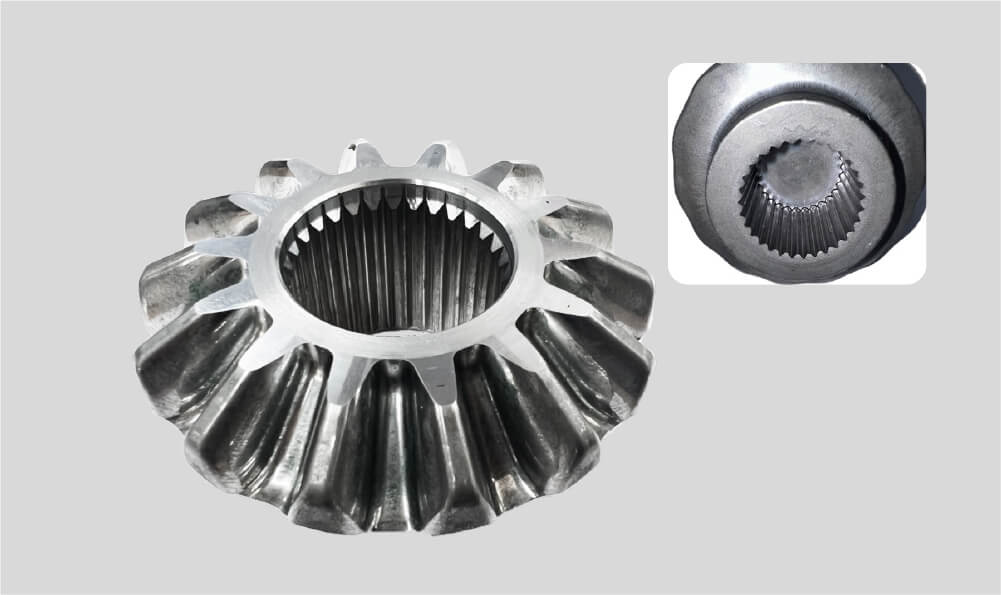
This development case study highlights a trial development of bevel gear forming via cold forging, in which the outer bevel gear section and the internal serration section were formed in the same process.
| Product Name | Bevel Gear |
| Application | Automotive Parts |
| Manufacturing Method | Cold Forging |
| Forming Load | 650tonf |
| Development Period | 3ヶ月 |
Development Background and Challenges
Traditionally, bevel gears are manufactured by forging the outer teeth and machining the internal serrations (splines).
As a result, multiple processes—forging and machining—are required, leaving room for improvement in terms of productivity enhancement and process integration. Furthermore, because the inner and outer shapes are processed in separate stages, appropriate process management and quality control are needed to meet the strict precision requirements for the components.
Achieving Superior Concentricity with Ease via Single-Shot Simultaneous Forming
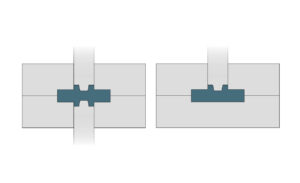
Utilizing a multi-axis double-action press, we conducted a trial development to form the bevel gear section and the internal serration section simultaneously in the same process.
In this development, we confirmed that a geometry traditionally manufactured through multiple processes can be successfully formed in a single shot. To achieve such complex forming, motion design that accounts for material flow and the optimization of operational timing for each axis are essential. We successfully realized this trial by combining our accumulated development experience with advanced CAE analysis. Furthermore, this method confirmed the feasibility of forming the internal serrations without machining, yielding valuable results toward future process integration and productivity enhancements.

Development System for Achieving High-Precision Bevel Gears
Forming high-precision bevel gears requires advanced “tooth profile compensation technology” to accurately predict and back-calculate the die design that account for die deformation under high forming loads and “heat treatment dimensional change.” Furthermore, our ability to integrate CAE visualization of the filling process and empirical evaluation using gear-meshing testers all in-house is a unique strength of Yamanaka Eng, thanks to our proprietary know-how and facilities. This thorough verification system is the key to achieving the targeted quality in the shortest possible time.
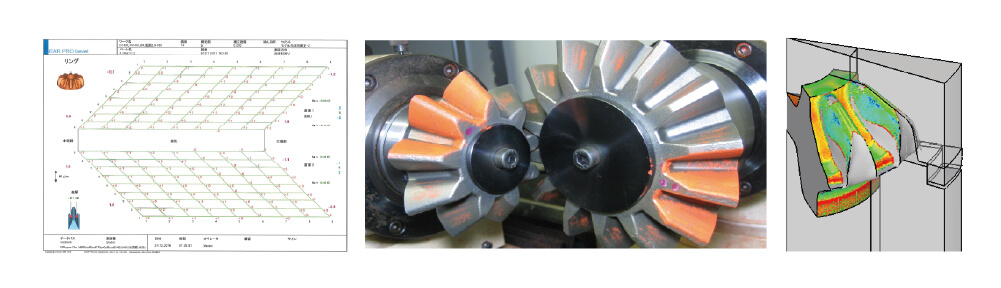
Integrated Development System and Reliable Quality Assurance to Meet Sophisticated Demands
Our strength lies in an integrated development system that merges state-of-the-art equipment, such as multi-axis double-action presses, with extensive development experience, forming know-how, and advanced CAE analysis.
In particular, our expertise in complex single-shot simultaneous forming is backed by advanced CAE technology, allowing us to identify optimal forming conditions in a short period and drastically reduce trial-and-error. Furthermore, our ability to provide high-precision geometries through proprietary tooth compensation and verify part accuracy using in-house gear-meshing testers ensures the highest quality requested by our customers. This is what sets our responsiveness to customer requirements apart.
If you are considering forging for any parts aimed at weight reduction, increased strength, or higher precision, please contact us. We offer high-level solutions to solve your challenges and provide powerful support for your product commercialization.
Author Profile

H.T Director, Solution Division, Yamanaka Eng Co., Ltd.
H.T is a veteran engineer who has dedicated his entire 43-year career to the field of forging. During his long tenure at a major automotive manufacturer, he mastered every stage of the process—from die design and equipment installation to new component launches and the development of advanced forging methods. His technical expertise is highly recognized in the industry, highlighted by his prestigious receipt of the "Sokeizai Industry Technology Award" on two separate occasions.