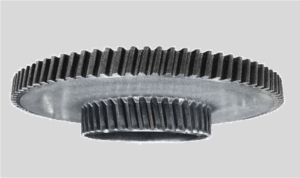
“Combining two separate parts compromises precision…”
“But machining them as a single integrated piece is cost-prohibitive…”
To solve this dilemma frequently faced in design departments, Yamanaka Eng Co.,Ltd. offers single-shot forming using our multi-axis double-action press. In this article, we introduce a development case study of a 2-step helical gear, an essential component for automotive transmissions and EV reducers. By forging previously separate components from a single blank in one single operation, we have achieved both compactness and high precision. Read on to discover the key technical highlights and innovations behind this breakthrough.
| Product Name | 2-Step Helical Gear |
| Application | Automotive (Transmissions / EV Reducers) |
| Material | SCM420(Case-hardening steel) |
| Dimensions | Large Gear Diameter:150φ / Small Gear Diameter:50φ / Height:90mm / Helix Angle:24° |
| Process | Cold Forging |
| Forging Load | 500tonf |
| Development Period | 3 Months |
Development Background and Challenges
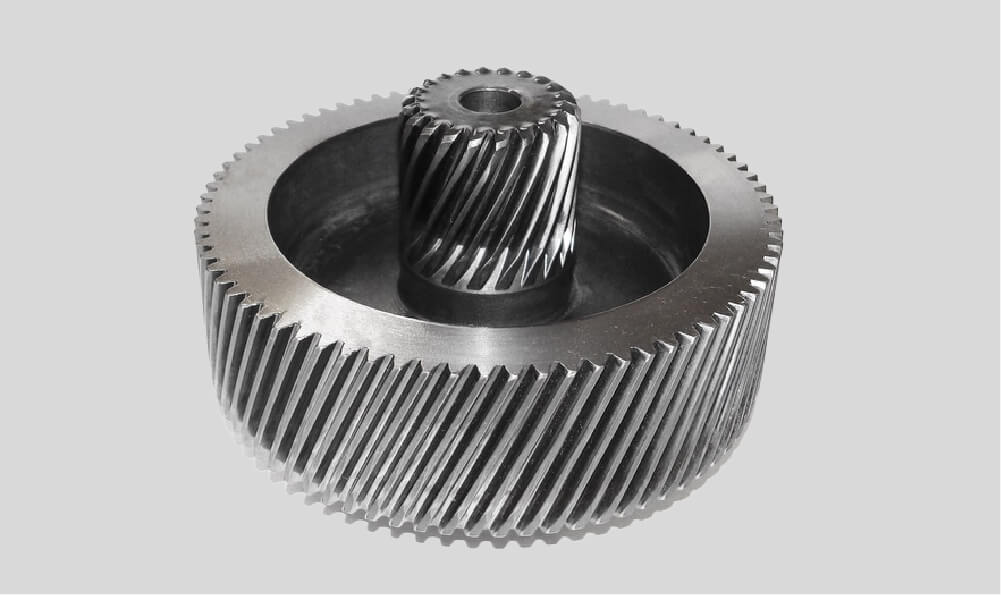
This product is a 2-step helical gear featuring a unique geometry where a large-diameter gear and a small-diameter gear overlap. It is widely used in automotive transmissions and EV reducers.
The most distinctive design feature is that part of the small gear is recessed inside the large gear.
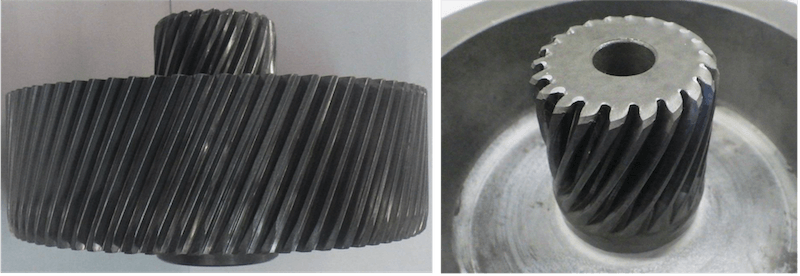
When viewed from the side, the roots and the incomplete teeth of the small gear are hidden inside the large gear section. This structure minimizes the distance between the gears to the absolute limit, enabling an extremely compact overall unit. However, manufacturing this specific geometry presented a massive hurdle.
Limitations of Conventional Processes
Manufacturing two separate gears and then joining them together increases the total part count, which drives up management costs for inventory and logistics. More importantly, as modern transmissions demand ever-higher precision, ensuring the required concentricity (tooth runout accuracy) becomes extremely difficult. The assembly process itself degrades precision, ultimately forcing compromises in final product performance.
Integrated machining via hobbing is physically impossible. While shaping/shaving is technically feasible, it requires extensive cycle times, high tooling costs, and significant material waste. This makes it economically unviable for mass production.
Balancing “part integration for higher quality” with “eliminating the gear-cutting process through forging for lower costs” is one of the major challenges faced by many manufacturing sites. Therefore, in this project, we formed the baseline component shape using a separate precursor process, and then applied our advanced forging technology specifically to the process of forming the two separate gear profiles (large and small diameters).
Single-Shot Forming of Two Gear Profiles Using a Multi-Axis Double-Action Press
By fully leveraging our core expertise in multi-axis double-action press technology, we established a process to forge both the large and small gear profiles onto a pre-formed workpiece in a single press stroke (single-shot forming).
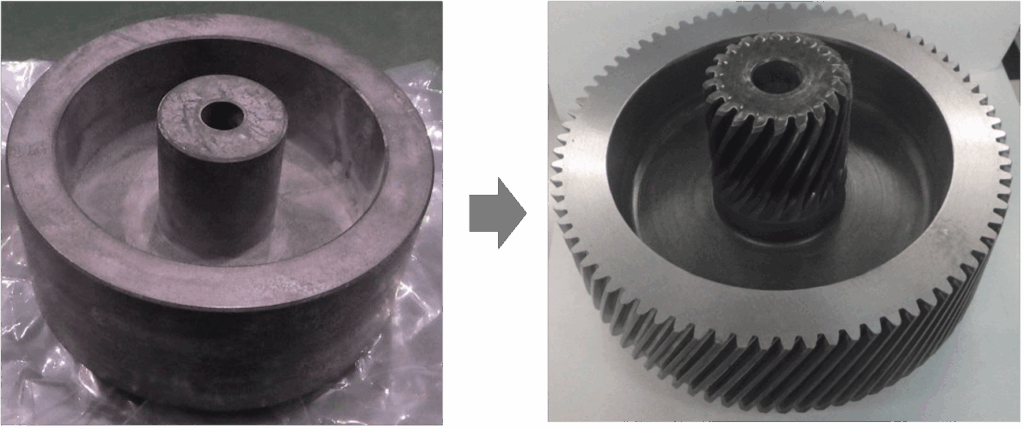
The greatest advantage of this method is the ability to form both the large and small gear profiles simultaneously within the exact same die set. This guarantees a high level of coaxial precision that matches or exceeds conventional methods where separately machined parts are assembled.
Furthermore, this forging approach using a multi-axis double-action press truly proves its value when forming a “recessed small gear inside a large gear”—a geometry where cutting tools physically cannot reach, or where machining would incur prohibitive cycle times and costs. The biggest benefit of utilizing forging here is the ability to minimize the incomplete tooth region. This allows the required effective tooth length to be secured efficiently even within a limited space, optimizing the component geometry and ultimately enabling the downsizing of the entire powertrain unit.
Optimizing Die Design with High-Precision CAE Analysis
To ensure the success of such a challenging single-shot forming process, we cannot rely on empirical rules alone; advanced pre-simulation via CAE analysis is indispensable. From the early design stages, we thoroughly verify the forming process in a virtual environment to optimize the die design.
Complex Motion Control
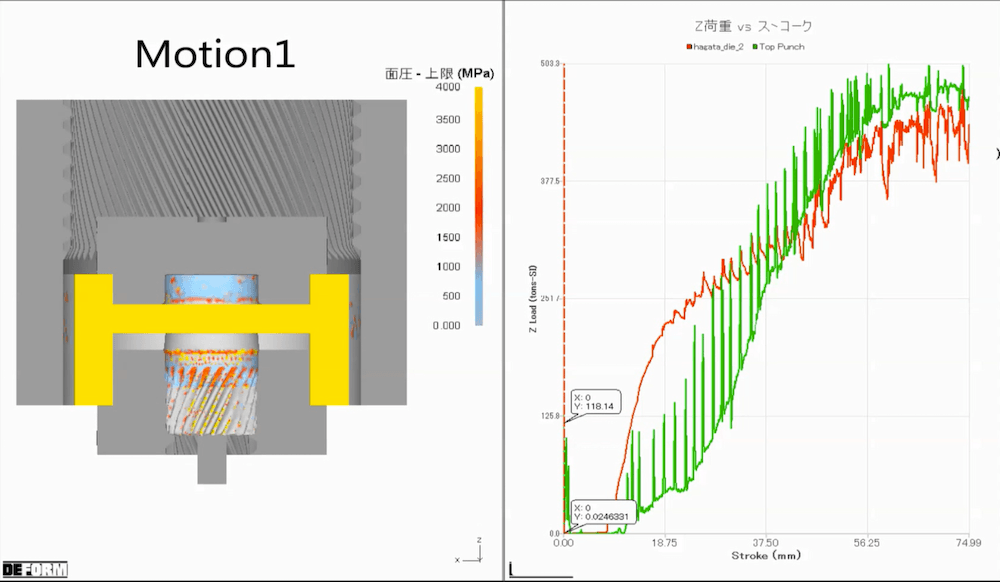
In this project, we adopted a specialized process within a single press cycle that transitions continuously from Motion 1: Forming the small gear diameter to Motion 2: Forming the large gear diameter.
By using CAE analysis to visualize this complex material flow within a single shot, we precisely controlled where, when, and how the material moves. This motion control stabilizes the dimensional accuracy of both distinct gear profiles at an exceptionally high level.
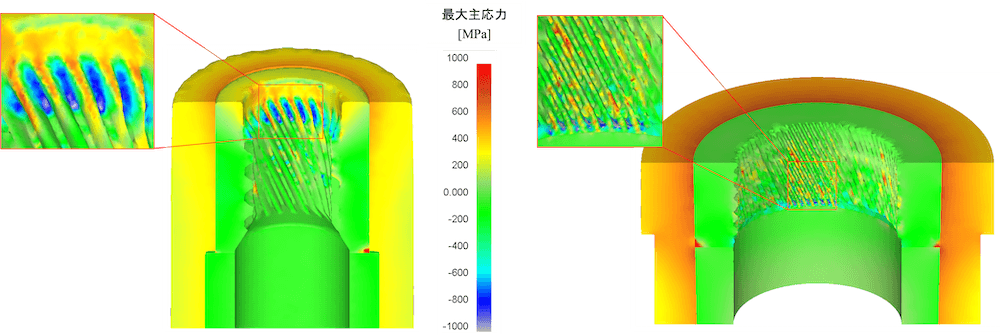
Eliminating Early Die Failure Risks (Maximum Principal Stress Analysis)
Forming helical gears—especially simultaneous 2-step forming—places an immense load on the tooling. To address this, we used CAE to quantify the stresses exerted on the dies during the forming of both the large and small gears. We identified areas prone to stress concentration and rigorously verified whether the maximum principal stress remained within the allowable limits of the die material.
By completely eliminating the risk of failure through pre-simulation, we prevent sudden die breakage after mass production begins, ensuring stable operation of the production line.
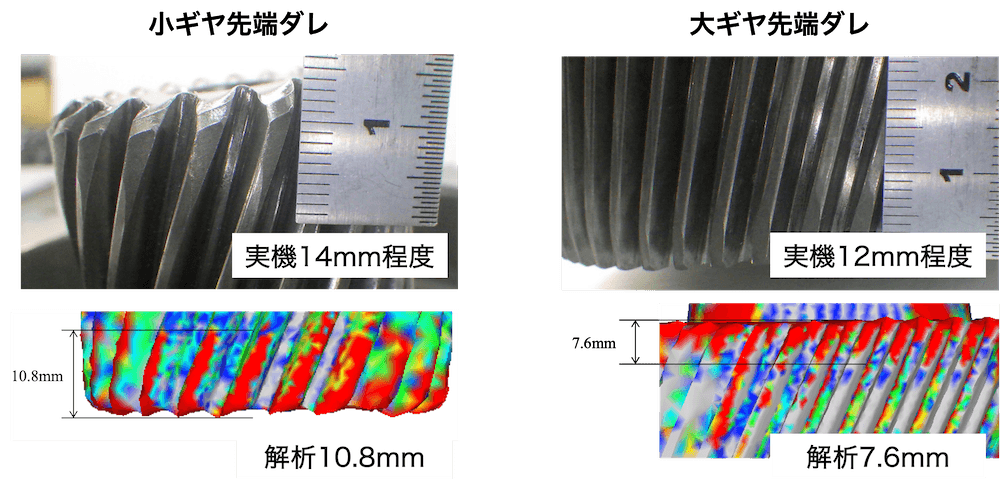
Highly Accurate Prediction of Gear Tooth Tip Filling and “Underfilling”
One of the most critical and difficult aspects of gear forging is ensuring the material fills the tooth tips as completely as possible. In our analysis, we evaluated the filling accuracy at the tooth tips using the metric of “minimum distance” (the clearance between the die and the material).
Remarkably, the tendency for tooth tip “underfilling” predicted by the analysis matched the actual machine test results with a relative error of only a few millimeters. Furthermore, by applying this correction, the prediction accuracy for subsequent relative comparisons approaches nearly 100%. This exceptional analytical precision is Yamanaka Gokin’s ultimate weapon, enabling us to reduce the number of physical prototypes and deliver highly accurate products exactly according to the design blueprints.
Next-Generation Transmission Design Realized Exclusively Through Forging
The greatest achievement of this development project lies not just in cost reduction, but in realizing the ideal component geometry that only the forging process can achieve.
Due to the physical constraints of conventional cutting processes, manufacturing a 2-step helical gear previously forced engineers to accept multi-piece structures or inefficient machining methods. By utilizing a multi-axis double-action press, we achieved single-shot integrated forging. This not only reduces management costs but also successfully delivers both high concentricity and the “recessed geometry” that directly contributes to a more compact powertrain unit.
This high-difficulty forming was made possible by our long-standing expertise backed by quantifiable data from CAE analysis. By visualizing the maximum principal stress on the dies and the tooth tip filling accuracy prior to prototyping, we determined the optimal solution, thereby shortening development times and building a highly reliable mass-production process.
“Forging such a complex shape must be impossible.”
“We want to integrate these parts, but we lack the manufacturing means.”
If you are facing these types of design challenges, please consult Yamanaka Eng Co.,Ltd.. We will leverage our accumulated technology and analytical capabilities to help shape your ideal designs into reality.
Author Profile

H.T Director, Solution Division, Yamanaka Eng Co., Ltd.
H.T is a veteran engineer who has dedicated his entire 43-year career to the field of forging. During his long tenure at a major automotive manufacturer, he mastered every stage of the process—from die design and equipment installation to new component launches and the development of advanced forging methods. His technical expertise is highly recognized in the industry, highlighted by his prestigious receipt of the "Sokeizai Industry Technology Award" on two separate occasions.