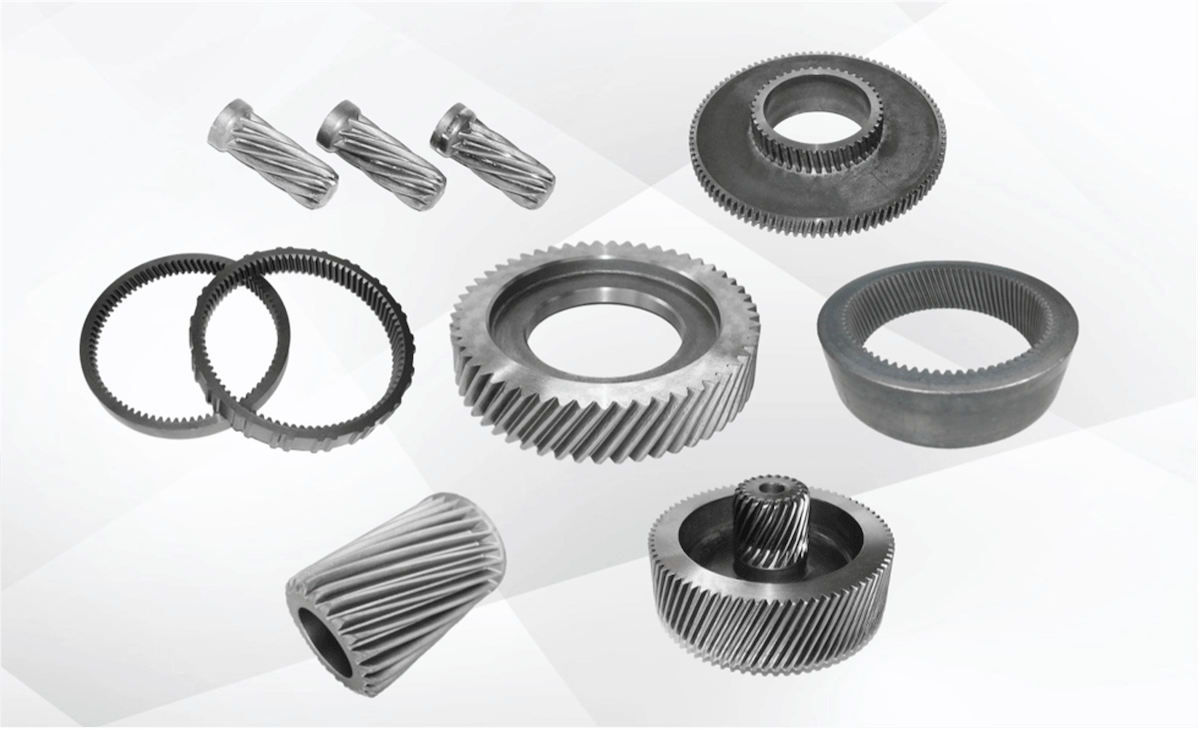
With the transition to electric vehicles (EVs) and the Shift toward electrified, high-output powertrains, helical gears are now required to deliver higher strength and unprecedented quietness. However, traditional manufacturing methods are reaching their limits in terms of both cost and performance, facing challenges such as massive material loss and long cycle times from machining, as well as the need to ensure the ultimate root strength required by next-generation units.
This article provides an in-depth explanation of the advantages of switching to cold forging—a method that overcomes the limitations of machining to achieve both high strength and excellent cost performance. We will also introduce Yamanaka Eng’s concrete approach to achieving high-precision mass production, utilizing a streamlined development process driven by advanced CAE analysis and proprietary die design.
What is a Helical Gear? Basic Knowledge, Main Applications, and Manufacturing Methods
A helical gear is a gear with teeth cut at an angle (in a helix) relative to the axis. Compared to spur gears, the angled teeth allow multiple teeth to mesh simultaneously, resulting in smoother power transmission and a dramatic reduction in noise and vibration. On the other hand, this design also generates an axial force (thrust load) during rotation.
Main Applications: Automotive transmissions, EV (Electric Vehicle) reducers, steering mechanisms, industrial robots, etc.
Conventional Manufacturing Method: Currently, the mainstream method is machining, where teeth are cut out from a cylindrical blank using hobbing machines or similar equipment.
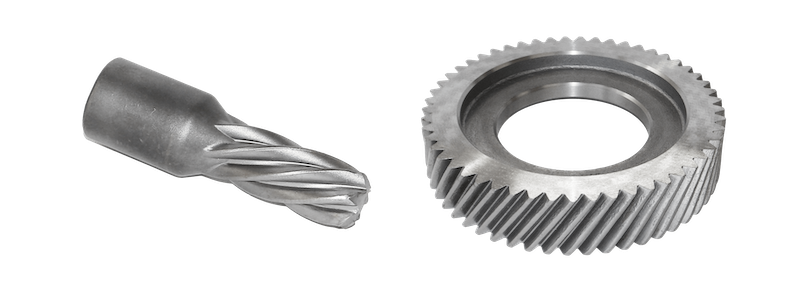
The Latest Trends in Helical Gears Driven by EV Transition and the Challenges of “Machining”
The ongoing transformation of powertrains, particularly in the automotive industry, is dramatically evolving the role expected of helical gears. The primary driver is the accelerating shift toward EVs. In an EV, where the internal combustion engine—the largest source of noise—is gone, even the slightest noise from gear meshing can drastically impact vehicle quietness. Consequently, the demand for helical gears that deliver higher precision and smoother rotation is greater than ever before.
Furthermore, with the high-speed and high-output characteristics of electric motors, the load applied per helical gear tooth is increasing. At the same time, the demand for lightweighting to extend driving range has become more stringent than ever. As a result, helical gears are currently required to meet contradictory specifications at a higher dimension: being more compact while possessing the high strength to withstand harsh torque.
However, conventional machining methods are reaching their limits under these strict requirements due to:
- High material loss from generating large amounts of chips.
- Long machining times required to cut complex tooth profiles, increasing costs and environmental impact.
- Reduced root strength, as machining cuts through the metal’s fiber structure (grain flow lines), making it difficult to secure the ultimate root strength required by next-generation compact, high-output units.
Because of these limitations, a process shift to cold forging—which can maintain precise tooth profiles while delivering superior strength and overwhelming productivity that surpasses machining—is becoming an inevitable trend in the industry.
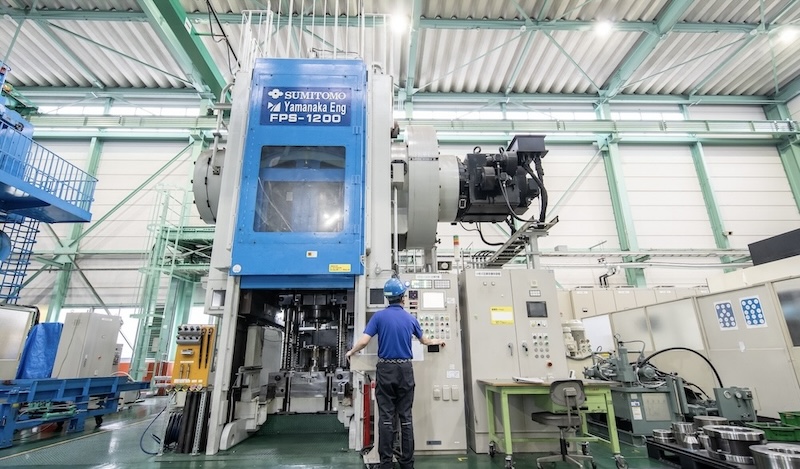
The Superiority of “Cold Forging” in Breaking Through the Limitations of Machining
Switching the manufacturing process from machining to cold forging goes beyond simple cost reduction; it fundamentally elevates the performance of the product itself.
| Evaluation Item | Machining | Cold Forging | Advantages of Forging |
|---|---|---|---|
| Material Yield | Low (Generates large amounts of chips) | Extremely High | Significantly reduces material costs. |
| Tooth Root Strength | Metal structure is severed. | Metal structure remains continuous (Grain flow lines). | Enhances root strength and provides high resistance to breakage. |
| Production Cycle | Long (Cut one by one) | Overwhelmingly Short | Reduces lead times during mass production. |
Because cold forging shapes metal by applying pressure without cutting, it not only reduces material loss to nearly zero but also keeps the metal structure uninterrupted. This allows for the simultaneous achievement of cost reduction and overwhelming root strength that outperforms machined parts.
Additionally, for components such as “two-step gears” or “herringbone gears (double helical gears)” where large and small gears are combined, machining requires either separate multi-piece structures or additional shaving processes, leading to high costs. In contrast, cold forging enables one-piece integral forming, which reduces both the number of parts and overall costs—another major strength of cold forging.
Helical Gear Forging Technology for High Precision and Long Tool Life (Yamanaka Eng)
To address on-site concerns such as “Can we achieve the required precision with forging?” or “Will the dies fail quickly?”, Yamanaka Eng delivers solutions through our proprietary die design and advanced simulation technology.
Core Technologies Supporting Tooth Profile Precision and Die Life
In helical gear forging, the most critical factor is the stability of the die shape (especially the tooth entry profile). We ensure high-precision helical gear forming by strictly implementing the following four points:
Identifying Optimal Shapes via Simulation:
We utilize CAE analysis to simulate material flow, deriving the “optimal shape for material flow” that eliminates restrictions and maximizes precision.
Precision Finishing Exactly as Designed:
We possess advanced machining technologies to replicate complex, simulation-derived shapes into physical dies with absolute precision.
Uniformity Across All Teeth:
We ensure that every tooth shares the exact same shape and surface condition, enabling stable forming with no individual variance.
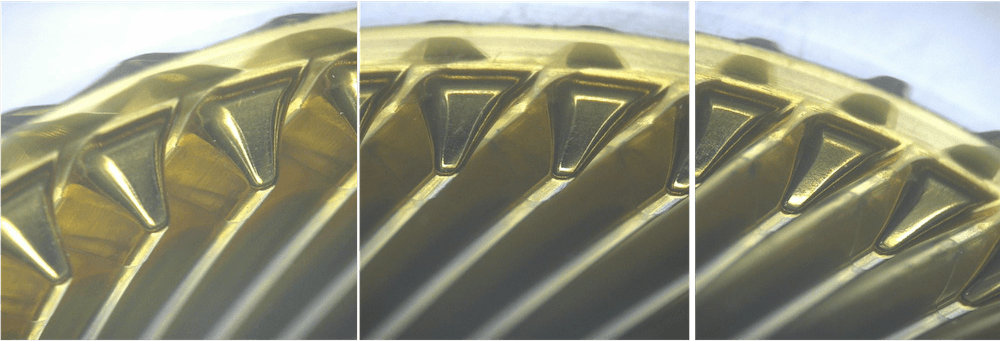
Overwhelming Reproducibility:
No matter when or how many replacement dies are made, we supply them with the exact same shape and surface roughness, directly contributing to the stabilization of mass-production lines.
Optimal “Process Selection” Based on CAE Analysis and Extensive Track Record
After carefully evaluating the customer’s required component shape and available equipment, we propose the most efficient and high-precision manufacturing process based on our extensive track record.
Diverse Approaches:
In addition to basic processes like forward extrusion and upsetting, we select the most suitable methods for complex shapes, including back-pressure utilization and closed-die forging.
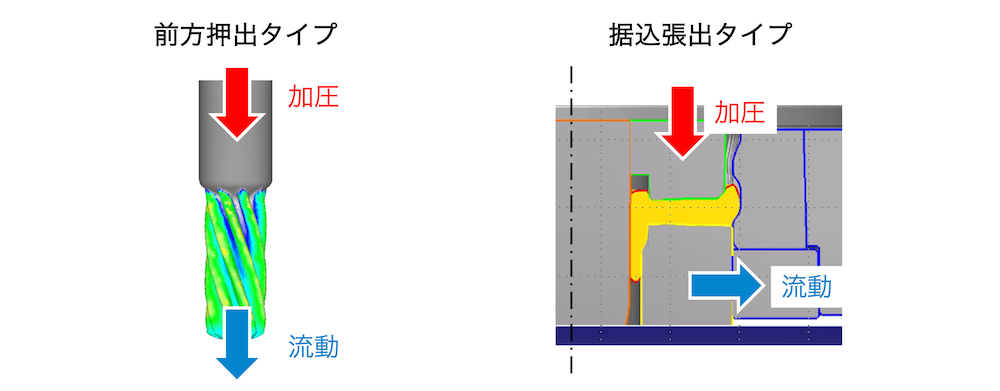
Utilization of CAE Analysis:
Because helical gears are twisted, the material flow during forging changes in a complex, three-dimensional manner. Utilizing highly optimized mesh (element) division techniques, our advanced CAE analysis visualizes localized stress concentrations inside the die, as well as material defects like underfilling (shrinkage) or folding before prototyping. By perfectly understanding material flow at the pre-trial stage, we reduce development costs and achieve mass-production startup in the shortest timeframe possible.
Forming Capabilities and Range for Helical Gear Forging
The feasibility of forging a helical gear cannot be determined by the “helix angle” alone. We judge the forming difficulty based on proprietary evaluation indicators that combine the helix angle and geometric characteristics to propose the optimal process.
Trends in Forming Difficulty and Product Examples
As the helix angle increases and geometric characteristics become more complex, the forming difficulty rises.
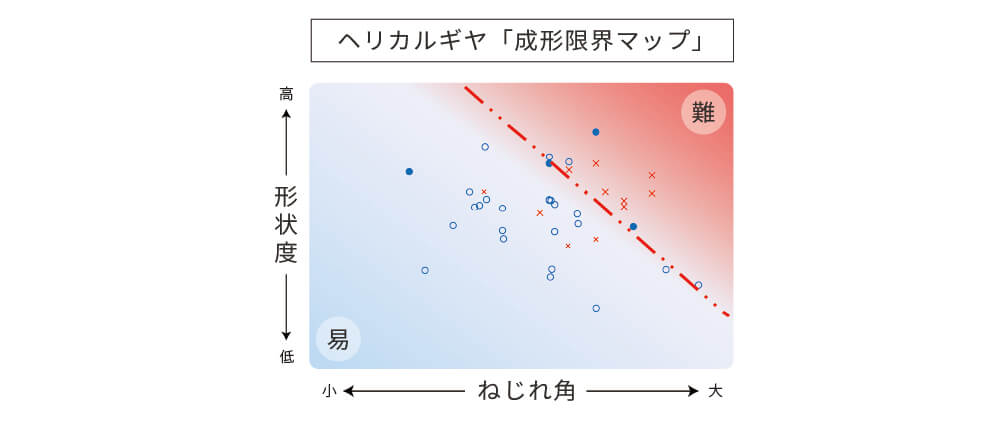
| Difficulty | Representative Component Examples |
|---|---|
| High (Difficult) | MT (Manual Transmission), EV Reducer (3-Axis Type) Units that allow rigid retention via bearings. They feature a large tooth surface area and require high transmission efficiency. |
| Medium | AT (Automatic Transmission), EV Reducer (Planetary Gear) To avoid excessive thrust loads due to the structure, the helix angle tends to be relatively gentle. |
| Low (Easy) | Rack & Pinion (Steering Components) Even if the helix angle is large, the tooth height is low, which stabilizes material flow and allows for high-precision forming. |
Even in fields classified as “High Difficulty” above, our company possesses a rich track record of successful development. Furthermore, we can propose optimal processes leveraging our accumulated know-how for specifications or unique shapes not listed here. Before concluding that a shape is “too difficult to forge,” please feel free to consult with us.
Strict Gear Precision Control and Total Design Based on New JIS Standards
We implement strict precision control based on the New JIS Standards, covering everything from die manufacturing to post-heat treatment stages. Our defining characteristic is that we design with a clear foresight into the post-forging machining processes.
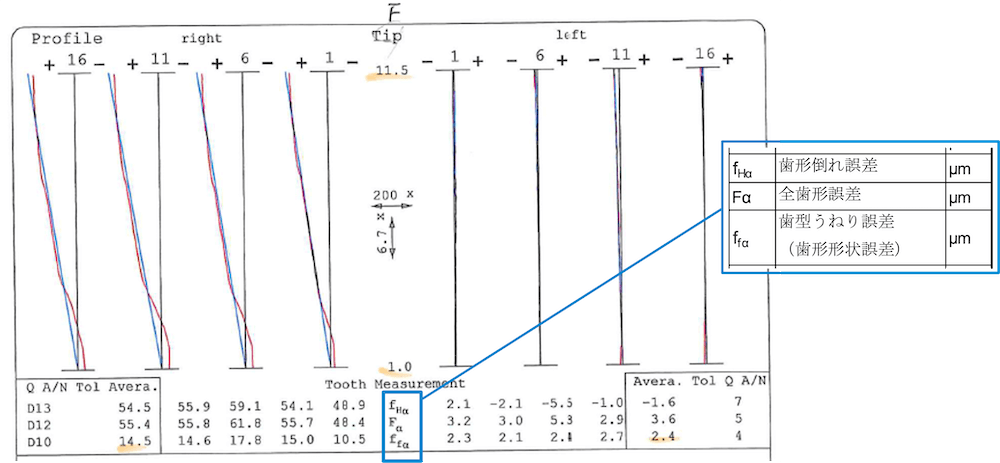
Inspection Data for Lead and Tooth Profile Errors
We conduct strict geometric tolerance and gear precision management based on the New JIS Standards using ultra-high-precision coordinate measuring machines (CMM by Leitz). We have established a quality assurance system capable of sub-micron level control that competitors cannot easily replicate.
“Post-Process Alignment” to Prevent Precision Degradation During Machining
During the precision measurement of forged parts, post-processes like machining can sometimes cause a degradation in precision.
To prevent this, we advance our forging design by pre-determining which features will serve as the datums for subsequent machining (such as ID turning). Accounting for post-processing during the initial design phase prevents significant degradation in gear quality grades after machining, ensuring final product precision.
Helical Gear Forging Development Track Record & Case Studies
Our advanced forging technology supports manufacturing across various industries, centered around the automotive sector. Here are some representative examples from our development and manufacturing achievements:
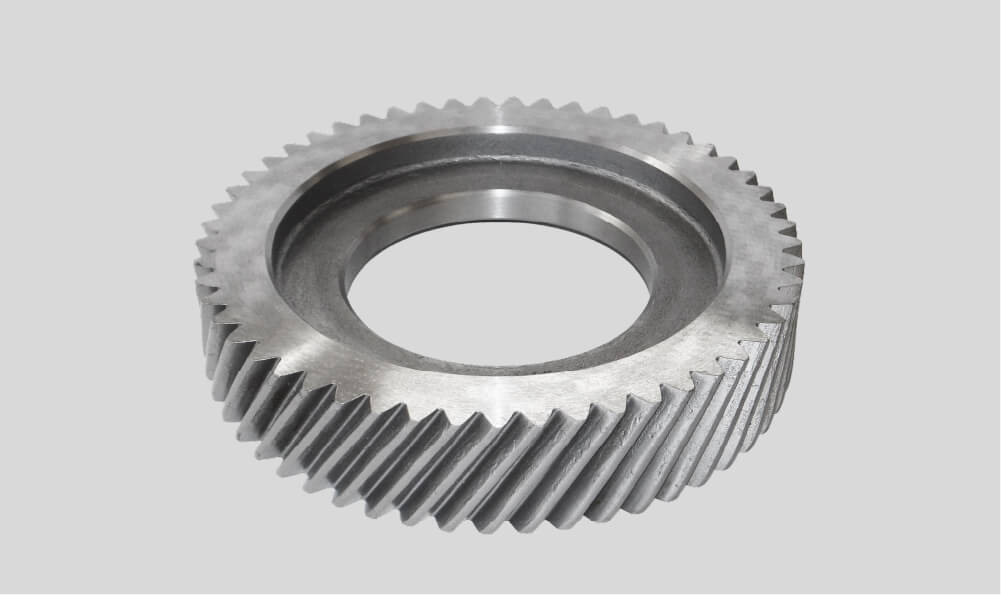
Helical Gear
Process: Warm split-flow upsetting
Material: SCr420
No. of Steps: 1 Shot
Forming Load: 700 ton
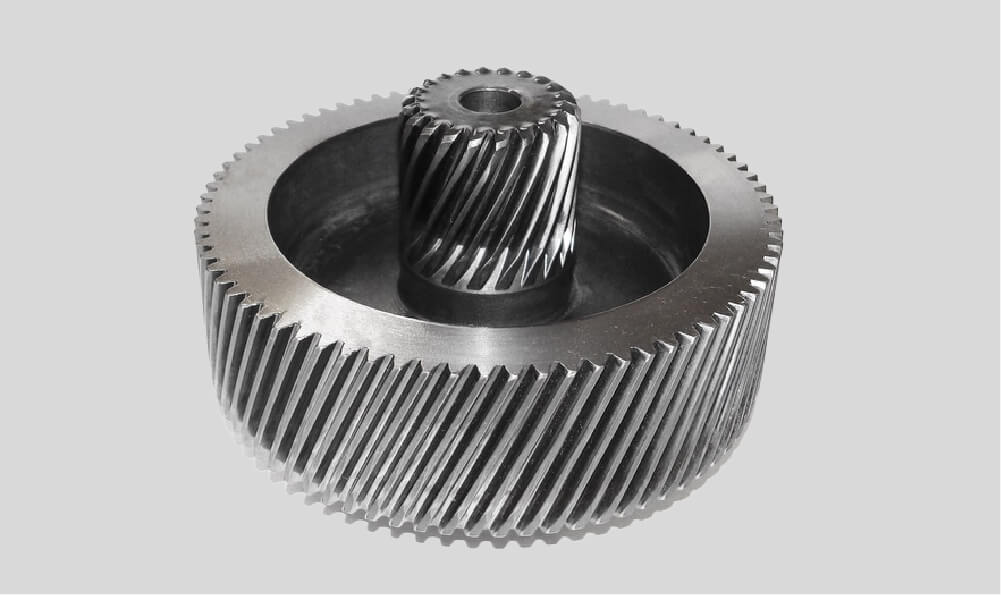
2-Step Helical Gear
Process: Cold forging
Material: SCM420
No. of Steps: 1 Shot
Forming Load: 500 ton
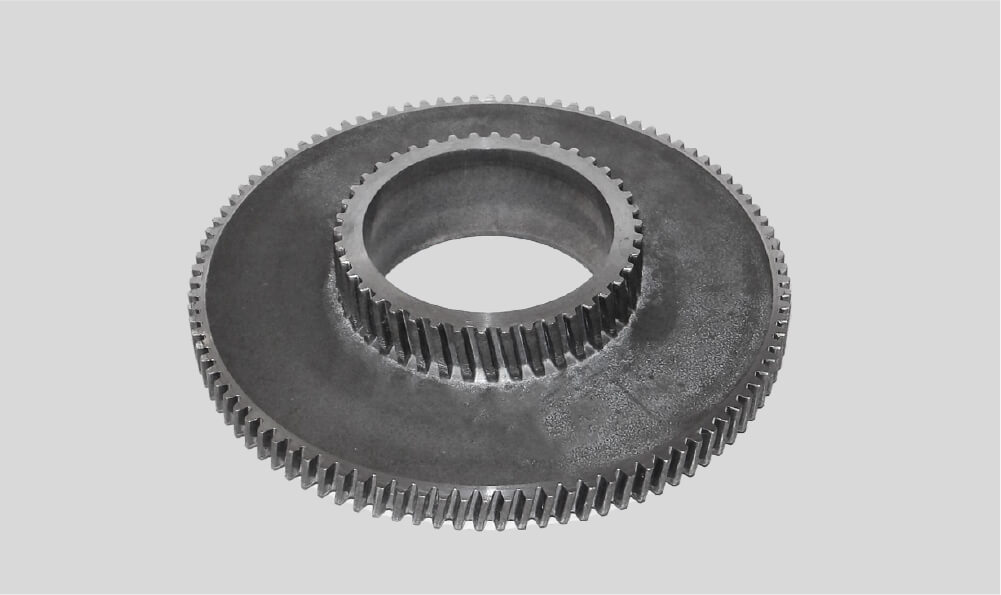
2-Step Helical Gear
Process: Cold forging
Material: S10C
No. of Steps: 1 Shot
Forming Load: 1100 ton
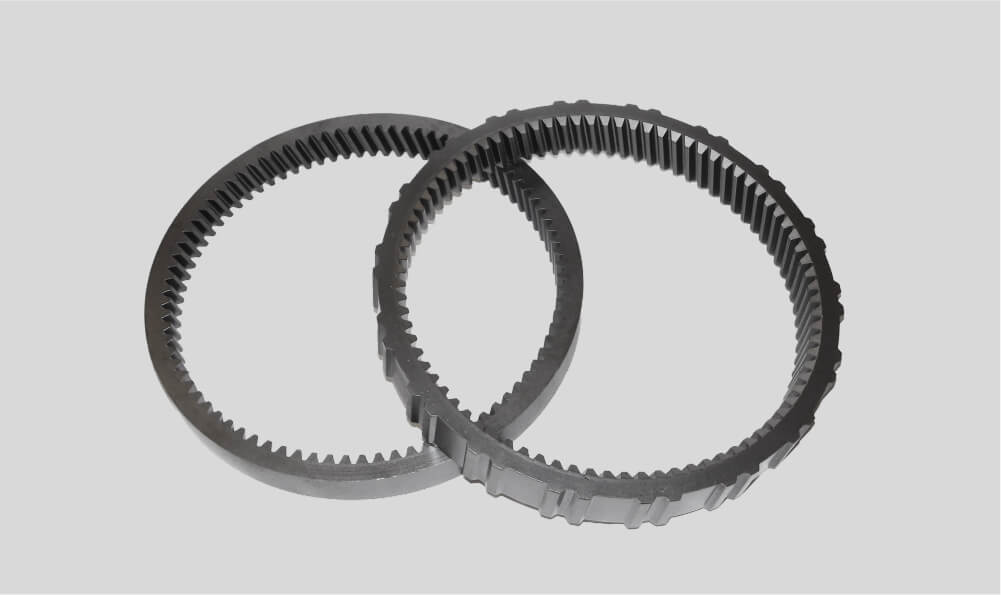
Internal Gear
Process: Cold forging
Material: SCM420
No. of Steps: 1 Step
Forming Load: 360 ton
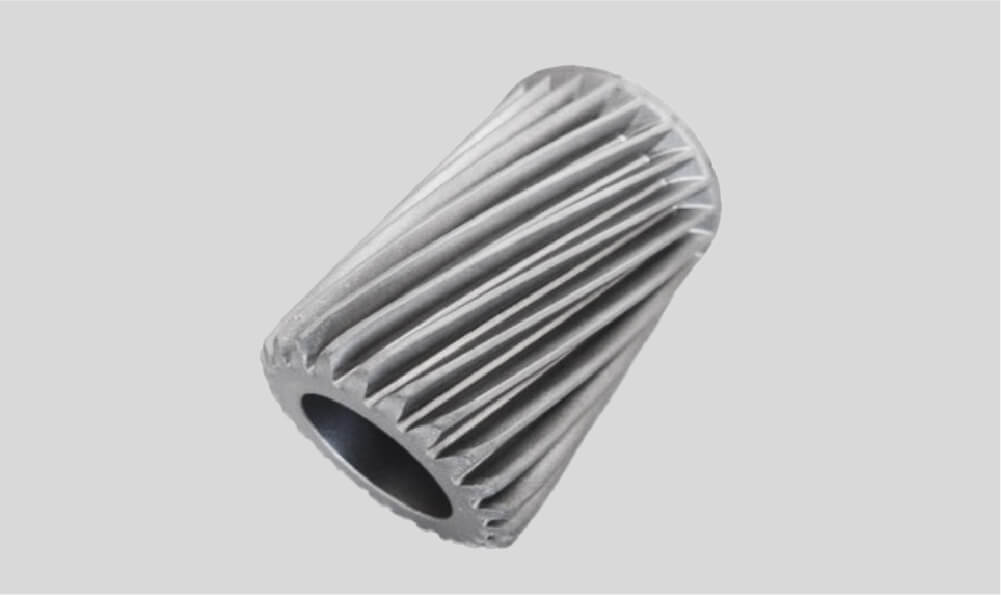
Sun Gear
Process: Cold forging
Material: S15C
No. of Steps: 1 Step
Forming Load: 150 ton
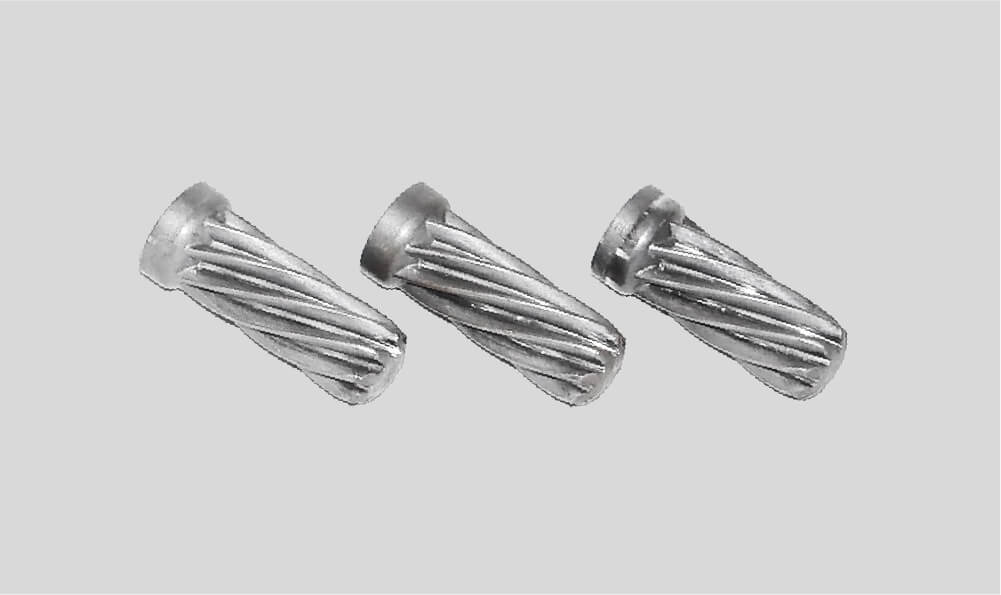
小型ヘリカルギヤ
Process: Cold forging
Material: S15C/SCM420/Aluminum/Copper
No. of Steps: 1 Step
Forming Load: 7 ton
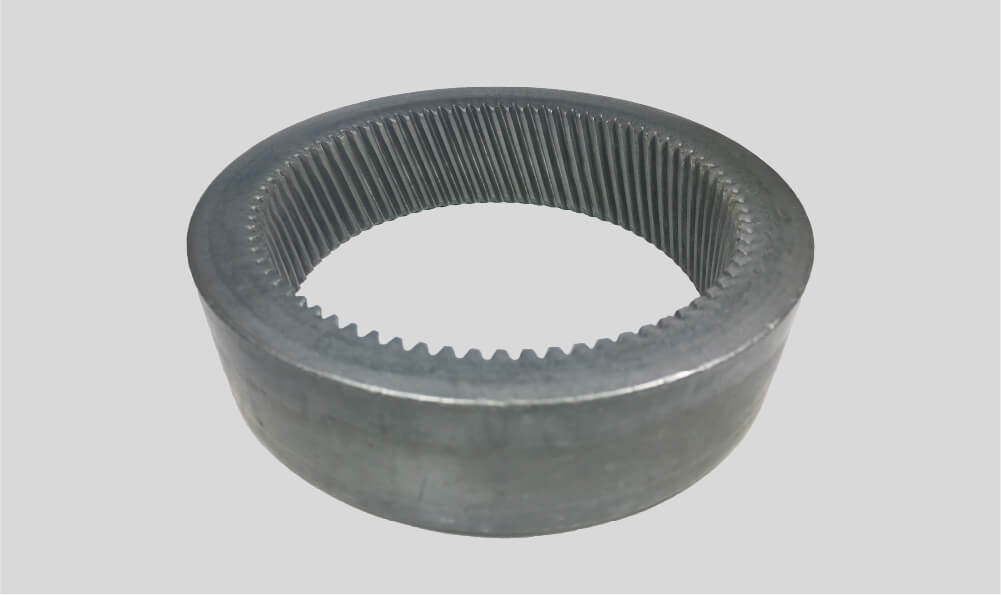
Internal Gear
Process: Cold forging
Material: SCr420
No. of Steps: 1 Step
Forming Load: 300 ton
For Helical Gear Forging, Consult Yamanaka Eng
In helical gear manufacturing, shifting from traditional machining to cold forging is the key to achieving high precision, improved quietness, and overwhelming cost performance.
Leveraging our advanced forging technologies and proprietary expertise developed over many years, we have successfully taken on numerous challenges to forge complex-shaped helical gears.
- “We want to reduce costs by switching from machining.”
- “We require higher precision and higher strength gears to match our electrification needs.”
- “We were turned down by another company saying that forging it would be too difficult.”
If you are a development or design engineer facing these challenges, please contact Yamanaka Eng. We will propose the most suitable solution, covering everything from process feasibility studies to prototyping.
[Click Here for Technical Consultation & Inquiries]
Author Profile

H.T Director, Solution Division, Yamanaka Eng Co., Ltd.
H.T is a veteran engineer who has dedicated his entire 43-year career to the field of forging. During his long tenure at a major automotive manufacturer, he mastered every stage of the process—from die design and equipment installation to new component launches and the development of advanced forging methods. His technical expertise is highly recognized in the industry, highlighted by his prestigious receipt of the "Sokeizai Industry Technology Award" on two separate occasions.